


Townhome vs. Condo vs. Single-Family on the Eastside: What Each Really Costs Beyond the Price Tag
Saturday, October 31, 2026
When buyers compare a townhome, a condo and a single-family house on the Eastside, they usually start with the price. That makes sense, but the price tag is only part of what you'll pay each month and over the years you own. Dues, insurance, shared repairs and even how your lender views the building can change the real cost by a lot. Here's how I walk buyers through it.
Where prices sit right now
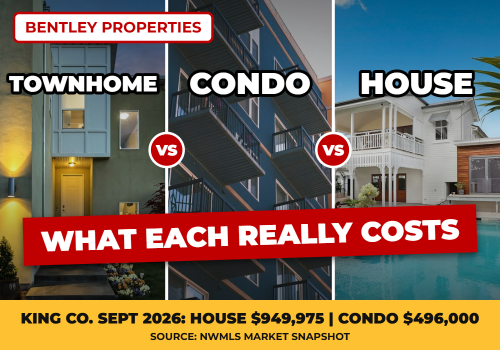
For a rough sense of scale, NWMLS reported a King County median of $949,975 for single-family homes in September 2026 and $496,000 for condos, which was down 6.0% from a year earlier. Beyond WA, which lumps condos and townhomes together, showed a $565,000 median for the county that month. Townhomes often aren't broken out on their own in public reports, so I don't want to hand you a single townhome number that isn't backed by data.
On the Eastside, one Bellevue market update citing NWMLS showed an all-Eastside median of $1,425,000 for houses and $600,000 for condos in September. That same report warned that some sub-area condo medians rest on about 15 sales, so they can swing sharply from month to month. Treat medians as a starting point, not a quote on any specific home.
One more data point that matters for condo buyers: NWMLS showed condo months of inventory at 7.0 in King County in September. More supply generally gives buyers more room to ask questions and take their time, though every building and every price point is different.
HOA dues: what they cover and what they don't
Dues vary enormously, so I'd rather give you the right questions than a made-up average. As one local example, a Bellevue brokerage guide says monthly fees in downtown high-rises are frequently $1,000 to $1,600, and that buys things like building staff and amenities. A small townhome community with no elevator, pool or front desk will usually look very different.
What matters is what the dues pay for. Ask for the budget and look for water, sewer, garbage, building insurance, exterior maintenance, landscaping and the reserve contribution. Two buildings with the same dues can be very different deals if one includes heat and water and the other doesn't, or if one is quietly underfunding its future repairs. A house has no HOA in most cases, but you pay for the roof, siding, driveway and everything else yourself, and those costs show up in big lumps rather than a monthly bill.
Insurance is not the same across all three
With a house, you insure the whole thing. With a condo, the association's master policy covers the building and common areas, and you carry an HO-6 policy for your belongings, liability and, depending on how the documents are written, your interior finishes. Whether the master policy is "bare walls" or "all-in" changes how much coverage you need inside your unit, so read the governing documents and talk to an insurance agent before you offer.
Two things to ask about specifically. First, the master policy deductible: that same local guide notes that boards now commonly carry $50,000 to $100,000 deductibles for major water claims, and bylaws often pass that deductible to the unit where the loss started. Second, loss assessment and deductible assessment coverage on your own HO-6, which can help if the association bills owners after a covered loss. Have your agent size it against the building's actual deductible.
Special assessments and reserves
A special assessment is a one-time charge when the association doesn't have enough cash for a big repair. They're most common when a building has deferred maintenance and thin reserves. That same guide describes a Bellevue case with a $45,000 assessment voted about two months after closing, and the buyer who walked away before closing avoided it.
Washington law generally requires condominium and HOA communities to maintain a reserve study, with annual updates and a professional on-site inspection at least every third year, and the resale certificate you request should say whether one exists. The statute was amended recently, so I'd have your attorney confirm the current rules rather than rely on my summary. When you get the reserve study, look at how much of the funding target has been met and at the multi-year cash projection. A high percentage can still hide a cash crunch if two large projects land in the same year.
Townhomes: the Joint Maintenance Agreement
Townhomes can feel like houses, but many share walls, roofs or other elements with neighbors, and some have little or no formal HOA. That's where a Joint Maintenance Agreement, or JMA, comes in. It spells out who pays for shared items such as the roof, siding, fences, shared driveways and utilities, and how decisions get made when owners disagree.
Before you offer on a townhome, ask for the JMA or the declaration, and read how repair costs are split, how the group votes and what happens if one owner can't or won't pay. If there's no written agreement at all, that's worth knowing before you commit. Also ask whether the community has any reserve account or whether every repair would be a fresh bill to the owners.
Financing differences
Lenders look at the building, not just you. For condos and some townhome communities, the lender will review the association's budget, reserves, owner-occupancy mix, litigation and any pending assessments. Under Fannie Mae guidelines, a local guide notes that at least 10% of the annual operating budget is expected to go to reserves, and a building that doesn't meet the criteria can be "non-warrantable," which may mean fewer loan options and higher rates. Lender standards change, so ask your loan officer early which buildings they can finance and what documents they'll need.
A single-family house skips that layer of review, which is one reason financing can feel simpler. It doesn't mean it's cheaper overall; it just means different risks.
Who each one tends to suit
First-time buyers often like condos and townhomes for the lower entry price and the reduced upkeep. The tradeoff is dues and shared decisions, so the paperwork review matters more than ever.
Downsizers frequently value lock-and-leave living and having someone else handle the exterior. For them, I'd focus on the dues, the insurance structure and how healthy the reserves look, since those costs continue for as long as you own.
Move-up buyers are usually looking at houses or larger townhomes. A house gives you more control and fewer shared decisions, but you take on all of the maintenance. A larger townhome can be a middle step if the JMA is clear and the community is well run.
None of these is better in every case. It depends on your budget, how long you plan to stay and how much responsibility you want.
What to review before you offer
For a condo or a townhome with an association, ask for the budget, the most recent reserve study, the resale certificate, the last year or two of board minutes, the master insurance information and any notice of special assessments or litigation. For a townhome, add the JMA or declaration. For any property, get your lender's read on the building and your insurance agent's quote before your inspection period ends if you can.
It's also worth building a simple side-by-side: monthly payment, dues, insurance, property tax and a rough yearly figure for repairs and upkeep. The home with the lowest price isn't always the one with the lowest cost of ownership.
This article is general information, not legal, tax, insurance or financial advice. Check current rules and the documents for any specific property with the right professionals.
If you're weighing a townhome, a condo and a house and want a second set of eyes on the numbers or the documents, reach out anytime to set up a quick call.
